Trusted AI
·
October 13, 2026
Which ROI-focused AI should you choose for your business in 2026
How much does it cost to implement internal AI? Find out in our latest article!

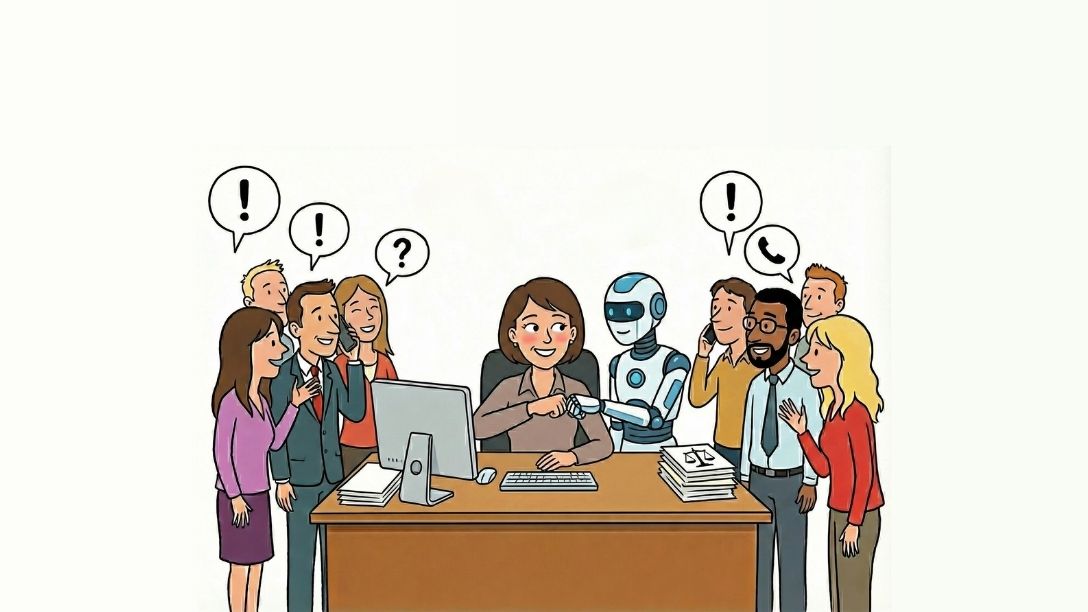
With an average of only one HR specialist for every 100 employees, human resources professionals are quickly overwhelmed... What if AI could help?

Human Resources teams spend hours on low-value, repetitive tasks like legal compliance research and answering routine employee questions. By implementing AI agents backed by Retrieval-Augmented Generation (RAG), companies can automate legal document searches and deploy instant employee FAQs using verified internal data. This ensures high accuracy, improves the employee experience, and frees up HR professionals to focus on strategy, recruitment, and human connection.
AI has made its way into many professional fields, and Human Resources is no exception to this transformation. While the profession involves numerous time-consuming tasks with low added value, discover how AI can assist HR professionals, freeing up their time to focus on what truly matters.
HR Directors, recruitment officers, assistants, or HR managers... These roles are at the heart of the company's strategic decisions and often serve as the link between management and employees. As the primary point of contact for staff, they are frequently solicited and often find themselves overwhelmed. Let’s discover together how to automate certain time-consuming tasks and free up time for HR teams (as well as for employees).
HR decisions almost always rely on legal constraints. However, it is impossible to know every current law and regulation like the back of your hand. Whether it is to answer an employee's question, defend the rights of an employee or the company, or implement strategic decisions, researching legal texts is an integral part of daily HR life.This tedious (and above all, time-consuming) task could easily be replaced by a chatbot powered by a database of legal documents validated in advance (thanks to the RAG method).In case of a question, doubt, or need to verify specific conditions, HR can simply converse with the agent, which will search for the information within its document base.That means hours of research and verification saved!
HR professionals are often the preferred point of contact for employees; however, in many companies, there is an average of 1 HR professional for every 100 employees. With this ratio, it is difficult to respond to every request. What is the company's leave policy? How do I access paternity leave? Which documents need to be filled out for a parking spot?All these questions can be handled by an automated conversational agent that will take charge of answering employee inquiries and providing documents if needed.A considerable time-saver for HR... and a better experience for employees, who receive a quick answer whenever they need it.
When using an AI agent for subjects as important as legal research or responding to employees, it is paramount to have access to reliable answers to correctly guide company decisions and employee actions.The solution for trustworthy AI? The RAG method!Designed to limit the risk of false, incomplete, or even invented answers, the RAG method involves providing the AI with a database of “verified” internal data.This way, the AI agent relies on the correct information. The challenge lies in controlling the sources that the AI is authorized to query.
By automating all these time-consuming tasks using AI, Human Resources professionals can concentrate on what truly counts: listening to employees, reflecting on and applying the company's HR strategy, conducting interviews, etc.For these professions, which must be attentive and embody the “human” side of an organization, freeing up time means making room to genuinely dedicate oneself to employees and being 100% available (both physically and mentally).
If you also wish to lighten your HR team's workload and optimize their efficiency, our experts can assist you. Contact us today!