AI Glossary - Part 1: The Fundamentals of Artificial Intelligence
Discover the first episode of our glossary miniseries, where we decode 50 terms behind AI.
Pascal CONDAMINE
·
Dec 9, 2025
⚡️ TLDR
Machine Learning basics: Decoding the three main machine learning methods: supervised (labeled data), unsupervised (pattern discovery) and reinforcement (learning through rewards/trial and error).
Data quality & performance: A model's accuracy depends on the relevance of its characteristics (features), the reduction of noise (irrelevant data), and the richness of the source database.
The trap of overfitting (Overfitting): A major point of concern that occurs when a model memorizes training data too closely, becoming unable to generalize to new, real-world data.
From model to production (MLOps): Industrializing AI projects relies on MLOps, a structural approach designed to automate, monitor, and maintain models at scale in a reliable way.
Artificial intelligence (AI) is now at the heart of digital transformation. From voice assistants and personalized recommendations to text and image generation, it is making its mark in every sector. But to understand AI, you first need to understand its vocabulary!
This artificial intelligence glossary was designed to help decode these key concepts and better grasp how machines learn, analyze, and make decisions.
Before diving into advanced technologies, let’s start with the foundations of AI—the essential concepts for understanding how it works, how it is trained, and how it is transforming our relationship with data. ⚙️
AI Basics
The foundations of artificial intelligence: what you need to grasp before diving into models and algorithms.
Artificial Intelligence (AI):
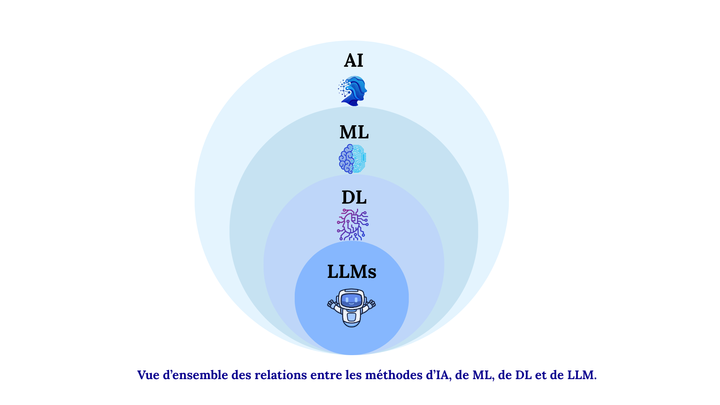
A scientific field that seeks to replicate or simulate certain human behaviors such as understanding, learning, reasoning, or creating, artificial intelligence combines mathematics, computer science, and data to perform complex tasks. Its goal is to design systems capable of adapting to their environment, improving their performance autonomously, and ultimately assisting humans in decision-making or problem-solving.
Algorithm:
A sequence of logical, ordered instructions that allows a machine to execute a specific task. It is the foundation of any computer program: each algorithm transforms an input into an output through defined reasoning. In AI, it is used to process data, train models, and guide their decisions.
Machine Learning:
A branch of AI where models learn from data without being explicitly programmed. The system identifies patterns, improves its performance, and adjusts its predictions over time through experience. It is the engine behind most modern AI applications.
Supervised Learning:
A training method in which a model learns from pre-labeled data, with each example providing the correct answer. By observing these correspondences, it learns to recognize patterns and generalize its knowledge. This approach is widely used for tasks such as classification, prediction, or image recognition.
Unsupervised Learning:
Unlike the previous method, the data here has no labels: the model explores on its own, searching for hidden structures such as groupings, correlations, or trends—a key approach for segmentation or anomaly detection.
Reinforcement Learning:
Inspired by human behavior, it relies on the principle of reward and punishment: an agent learns through trial and error, adjusting its actions to maximize a performance score. This approach is used in robotics, gaming, and the optimization of complex systems.
Database:
An organized system for storing, structuring, and querying information efficiently. Databases form the foundation of any AI project by ensuring data availability and quality, as a robust database is essential for the reliability of the models trained upon it.
Classification:
The task of assigning a category to data based on its characteristics. For example, classification can determine whether an email is "spam" or "not spam." It relies on models capable of learning from labeled examples to recognize patterns and generalize those learnings to new data.
Correlation:
A statistical link between two variables, describing the tendency of one to vary when the other changes. However, correlation does not imply causation: two phenomena may appear linked without a direct relationship between them. Understanding this distinction is essential for interpreting data correctly and avoiding false conclusions in AI models.
Noise:
Irrelevant or extraneous information present in a dataset. Noise can stem from measurement errors, data entry issues, or random phenomena that lack explanatory value. Excessive noise can disrupt a model's learning process and skew its predictions. Reducing noise improves signal clarity and strengthens the reliability of analyses.
Data:
The raw material of any artificial intelligence, data fuels models, influences their results, and determines their reliability. The richer, more varied, and better structured the data, the more an AI gains in performance, precision, and relevance in both its predictions and decisions.
Overfitting:
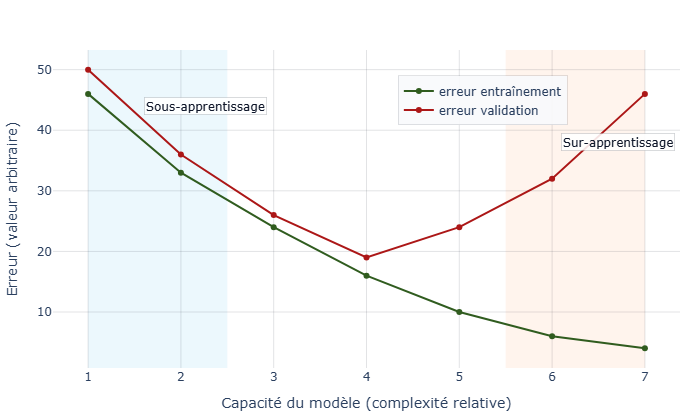
A phenomenon where a model learns training data too closely, memorizing even the most minor details. Overfitting reduces a model's ability to adapt to new situations. The model performs exceptionally well on its training set but struggles with unseen data. Avoiding this is essential to ensure the model can generalize and produce reliable results in real-world contexts.
Training:
The phase during which a model learns to recognize patterns or make predictions. Training involves progressively adjusting parameters to reduce the error between the model's output and the expected values. As a crucial step in AI development, it often requires significant time and computing power, but it directly determines the performance and reliability of the final model.
Feature:
A measurable element or property used by an AI model to learn from data. For example, the color or size of an object can be features in a vision model. The quality and relevance of these features directly influence the model's accuracy and performance.
Model:
A mathematical representation of a phenomenon, an AI model is trained on data to capture regularities and patterns. It learns to predict, classify, or generate new information based on the examples it has received. Its performance depends closely on the quality, diversity, and relevance of the data used, as well as the care taken during its training.
MLOps (Machine Learning Operations):
A set of practices that unite machine learning, software development, and IT operations to industrialize artificial intelligence projects. MLOps aims to automate the entire lifecycle of a model, from training to production deployment, while ensuring continuous monitoring. It facilitates collaboration between data scientists and engineers, ensuring the reliability, traceability, and performance of models used at scale.
By mastering these concepts, you lay the necessary foundation to understand how AI learns, adapts, and makes decisions.
But knowing the principles isn't enough: you also need to understand the technologies that power AI, such as those enabling image recognition, natural language processing, and content generation.
Continue your exploration in part two: The technologies powering AI and download our glossary : "The 50 words behind AI."
Ready to see what your data really has to say? Let it speak with our experts. Contact us today.
Subscribe to our Newsletter
Stay up to date with the latest news, articles, and updates. Subscribe now!
Thank you! Your submission has been received!
Oops! Something went wrong while submitting the form.


_Craft%20AI.jpg)