MLOps

Why MLOps is every data scientist’s dream? Part 2

We will try to provide some answers to this questions in two parts. This second article focuses on the first deployment and iterations to quickly improve it while the first one focuses on conception, data collection, exploration and application prototyping.

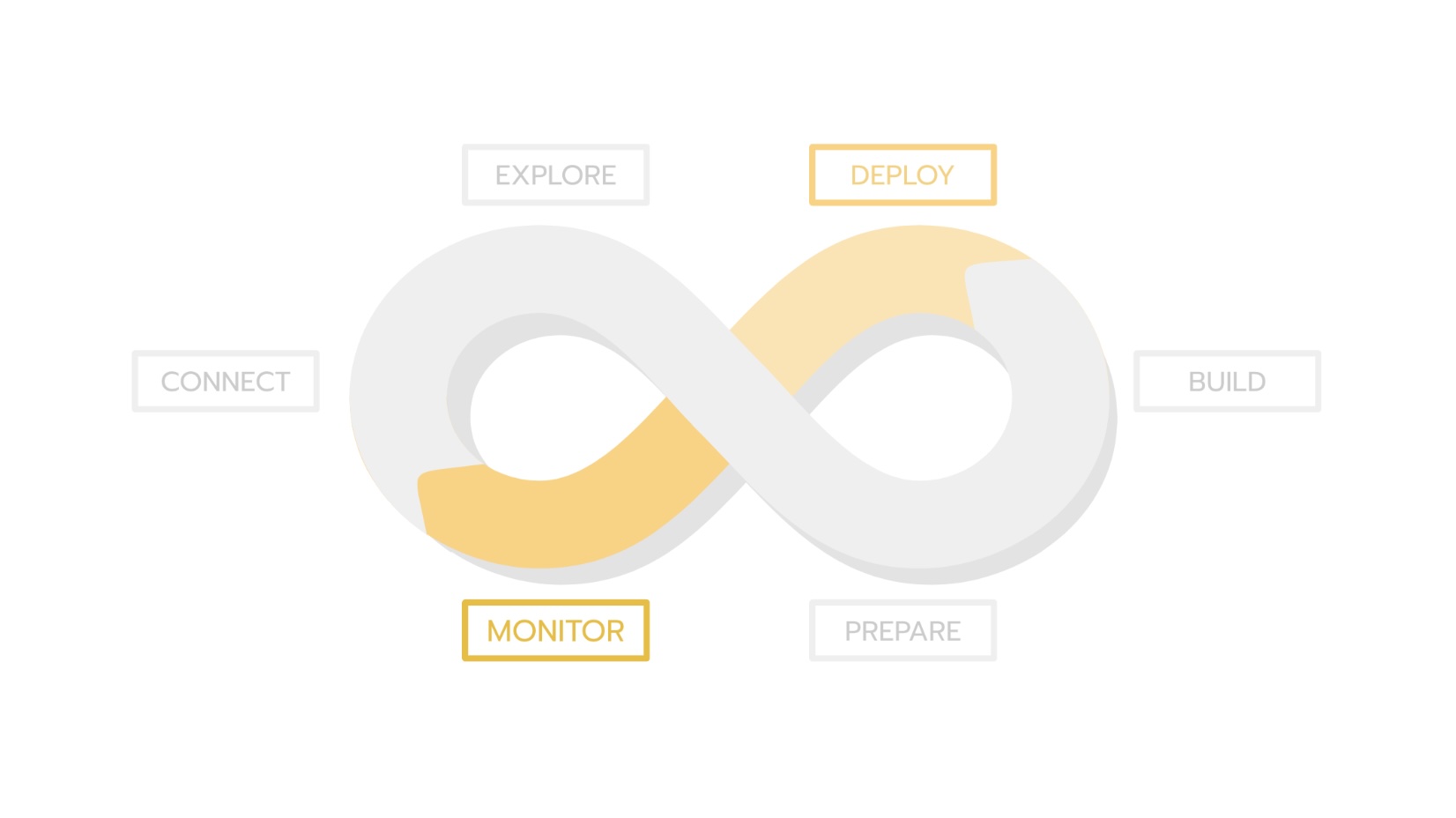
As we have seen in the previous article (Why MLOps is every data scientist’s dream? Part 1: Starting an AI project), MLOps accelerates the AI application design from its very beginning (infrastructure set-up, data collection and prototyping). However, it also brings tremendous benefits for the users themselves by allowing the data team to deliver and improve an application in a real-life context of use (or in “production”)
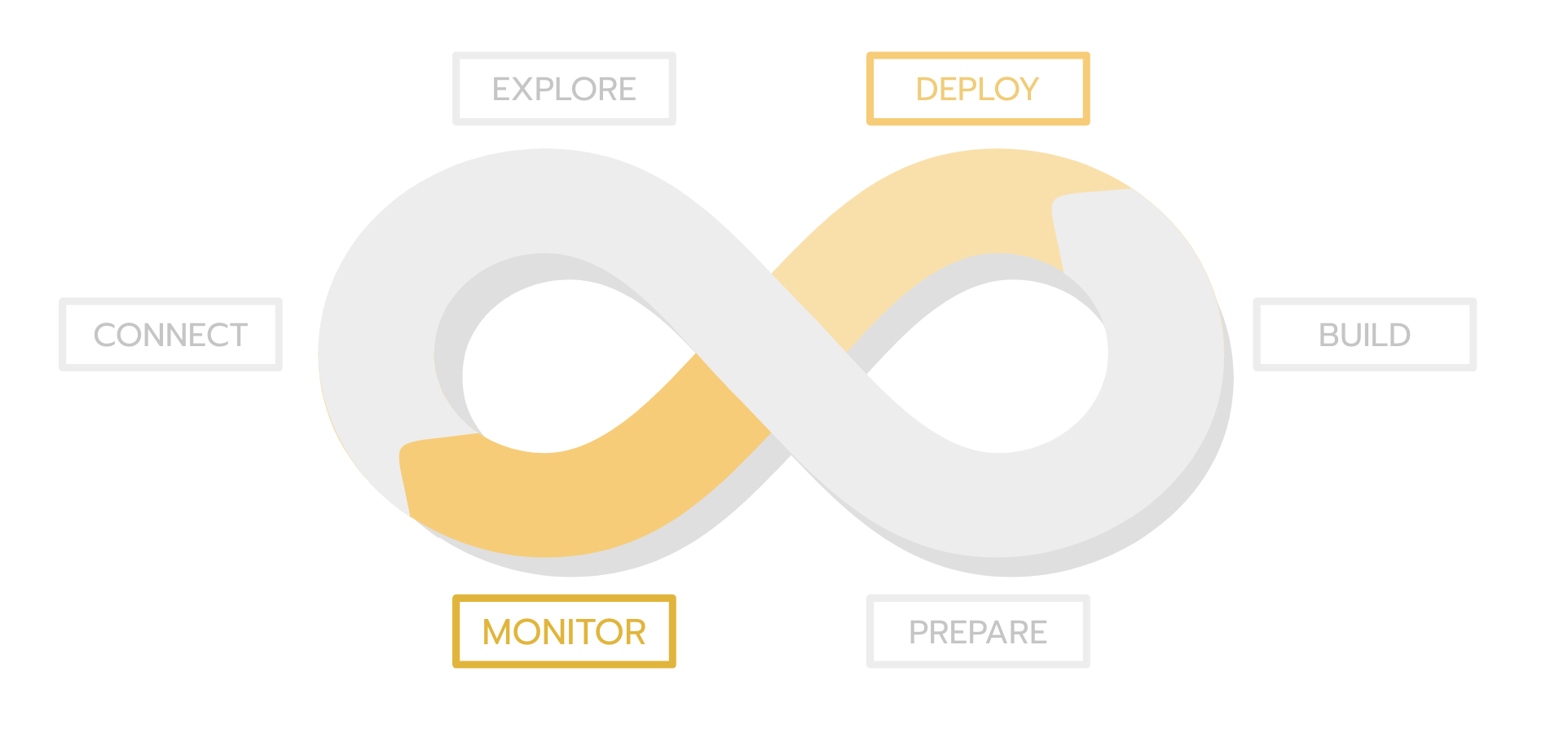
Deploy & Monitor

The main MLOps feature that unlocks all the others is to give data scientist the ability to deploy their machine learning pipeline. 87% of AI project don’t even make it to production phase and the first goal of MLOps is to make this number smaller and smaller.

There are two main reasons behind this number.

  • First deploying a robust and secure AI application in production requires a close interaction between data science knowledge and DevOps skills such as setting up servers, writing an API, adding authentication mechanisms, embedding your code in a docker image, orchestrate the different services with Kubernetes. DevOps ressources are not always available and when they are, the collaboration between teams make this whole process long and tedious. In a MLOps context, the DevOps team would simply set up and configure tools that will then enable data scientist to be completely independent to put their models into production, breaking the wall of industrialization.
  • The second reason is that when deploying your models is hard, you tend to stay in the experimentation phase for a long time and when the time comes to put your sophisticated machine learning pipeline in the hand of the end user, whether a person or another program, you often realize that your application doesn’t fully fit your user’s needs. This is completely normal and should be expected. You can never anticipate everything, data changes over time, so does the user need and there are things you can only realize when you put your application to the test of the real world. But seeing your model fail after months of experimentations kills a lot a AI projects. That is why it is so crucial to put a first simple model in production as soon as possible and iterate.

However, deploying an AI application is nowhere near the end of a data scientist’s role in an AI project life cycle. What happens to the model once released? How its performance evolves over time? Does the model need retraining? On which criteria? Are there specific cases in which the performance is low ? Does it sometimes fail and why ? Is it used by the end user ? Will it require bigger machines soon ? If so what is the bottleneck : CPU, RAM, the disk? … These are some of the questions a data scientist has to ask himself to improve an AI application in a meaningful way. To answer all these questions, he needs to monitor a large variety of metrics : model performance metrics, statistics on input data and predictions, usage metrics, execution logs, machine usage… Setting up all this monitoring in can be very challenging and data scientist usually don’t have the expertise or the time to build it. MLOps tools not only allow you to deploy your models easily, it also provides you with all the monitoring you need to make the right decisions. It gives you access to both ready-made metrics like machines usage, but also to custom metrics that you can design to get the most useful insights for your application.

With the ability to deploy and monitor your AI applications in your hands you can now work in fast iterations through the whole machine learning cycle. That is why the primary job of MLOps is to enable data scientists to put their own model into production in a reliable, scalable and easily maintainable way and to make it so easy that it becomes just another data science task.
Let’s iterate on the MLOps cycle ! Engage the business teams, collect feedback and fastly adjust your solution to the real needs

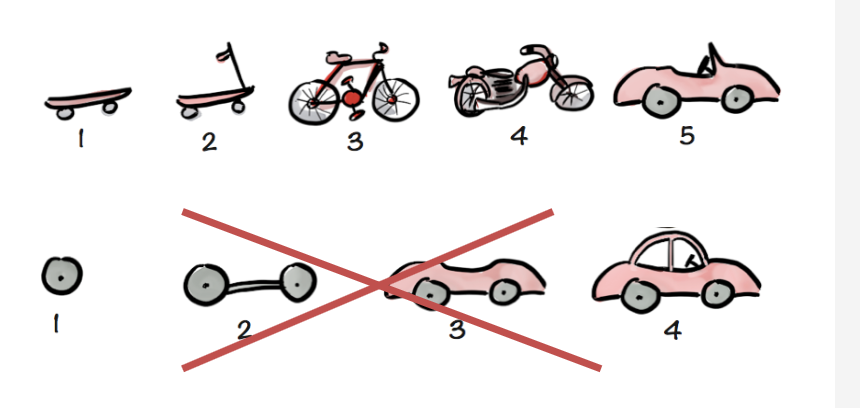
MLOps aligns all stakeholders on a common goal: the delivery of a user-centric AI application that end users can quickly bring into play. Indeed, any AI solution, no matter how technically good it is, that is not used cannot be considered a success. As we have seen previously, ith the automation of repetitive tasks and the ability to reuse previous work, the data scientist can deliver product increments faster and continuously adapt to shifting user needs. MLOps can be seen as an agile framework application on machine learning solutions. For instance, if you need a means of transportation available shortly, maybe getting a bike will be sufficient in the first few weeks. You may not have to wait for a complete and state-of-the-art electric car that would take several years to deliver and whose functionalities would not suit you.

MLOps reduces the duration of iterations on AI projects and puts the end-users at the heart of them. Data scientists no longer focus solely on the performance of their models but also on the design of a comprehensive and user-centric product. The benefits are numerous:

  • Business teams, by seeing results integrated into their daily processes and available in a few weeks, feel much more involved in the project and feel like allowing more time to it
  • Even if the solution is imperfect, it lets data scientists collect more precise and structured feedback on their work by presenting concrete results
  • The metrics shared with the team are no longer centered on models performance, but rather on the product use: availability of the service and results, acceptable latency, frequency of re-training...
  • When the need evolves, the speed of adaptation is increased thanks to the reusability of elements already developed (data ingestion & inference pipelines...). The data scientist saves time to focus on end-user satisfaction

We see here that MLOps brings teams together and breaks down silos. It enables a much more collaborative, iterative way of working, focused on the final value delivered to end-users.

Finally, MLOps provides strong Benefits along the hard way of delivering AI applications to end-users

At every stage of the project, MLOps empowers Data Scientist and provide them more autonomy and comfort while realizing their day-today activities. MLOps unlocks a new way of working and provide Data Scientists all the tools they need to reduce frictions and personal frustrations along the difficult road of AI applications delivering.

In addition, it allows them to improve collaboration with every stakeholders, and mostly end-users, and simplify the iteration process in order to build an AI solution centered on the real business needs.

Finally MLOps reduce all the risks associated with the project and make the gap between experimentation and industrialization disappear by allowing Data Scientist to build a solution that is “production-ready” from the start.

Written by Raphaël Graille, Senior Data Scientist & Roman Vennemani, AI Architect

Niveau de Risque Exemples d'applications Statut & Obligations
🔴 Inacceptable Notation sociale, scoring biométrique politique/religieux, reconnaissance des émotions au travail/école, moissonnage d'images faciales. Interdit
En vigueur depuis le 2 février 2025.
🟠 Haut Risque Systèmes de tri de CV/recrutement, évaluation du crédit bancaire (credit scoring), infrastructures critiques, éducation. Sous conditions
Autorisé sous conditions strictes : supervision humaine, journalisation, marquage CE.
🟡 Limité Chatbots, générateurs de contenus (images, textes). Transparence
Obligation de transparence (mention explicite "Généré par IA", watermark).
🟢 Faible / Minime Outils de productivité de base, filtres anti-spam. Recommandations
Pas d'obligation légale spécifique, mais des recommandations de bonnes pratiques.

Le cas particulier des GPAI (Modèles d'IA à usage général) : Les grands modèles de langage (LLM) comme Mistral AI, OpenAI ou Claude entrent dans un régime propre. Soumis à une application progressive, ils nécessitent des analyses d'impact approfondies pour évaluer les risques selon s’ils sont utilisés bruts, fine-tunés ou intégrés via API.

3. La Méthode "RADAR" pour Auditer ses Cas d'Usage

Développée par Xavier Trigano, la méthode RADAR permet à toute organisation de piloter sa mise en conformité de manière itérative :

  • R – Recenser : Cartographier exhaustivement tous les cas d'usage de l'entreprise (outils internes pour les collaborateurs et solutions commercialisées).
  • A – Attribuer les rôles : Identifier si l'organisation agit en tant que Fournisseur de modèle, Fournisseur de système d'IA, Intégrateur ou Déployeur (utilisateur final). Une même entreprise peut cumuler plusieurs rôles.
  • D – Déterminer le risque : Qualifier le niveau de risque selon le type de cas d’usage et sa finalité (Inacceptable ? Haut risque ? Limité ? Faible ?).
  • A – Appliquer les mesures : Mettre en œuvre les actions techniques et organisationnelles requises par le niveau de risque identifié.
  • R – Rédiger la documentation : Constituer le registre et les preuves de conformité (similaire à la logique de l'accountability du RGPD).
Focus "AI by Design" - L'exemple du tri automatique de CV : Un outil RH qui exclut ou accepte des candidats de manière 100 % autonome est classé "Haut Risque", avec un coût de conformité très lourd. La méthode RADAR recommande plutôt une approche by design : modifier les fonctionnalités de l'outil pour en faire un simple système d'aide à la décision (qui extrait les compétences clés du CV mais laisse la validation finale à un recruteur humain). L'outil apporte la même valeur métier, mais bascule en risque limité, allégeant drastiquement les contraintes légales.

4. FAQ : Shadow IT, RGPD et Souveraineté

Comment lutter contre le Shadow AI en entreprise ?

L'interdiction pure et simple ne fonctionne pas. Pour maîtriser l'usage des LLM par les collaborateurs, la réponse doit être transverse :

  • Définir un catalogue d'usages autorisés sur la base d'outils sécurisés mis à disposition.
  • Utiliser des solutions technologiques de DLP (Data Loss Prevention) pour bloquer le chargement de données sensibles vers des LLM tiers.
  • Mettre à jour la charte informatique et le règlement intérieur.

L'usage des LLM (ChatGPT, Claude...) viole-t-il le RGPD ?

Ce n'est pas l'outil qui caractérise la violation, mais la finalité de l'usage. Reformuler une campagne marketing sur Claude ne présente aucun risque RGPD. En revanche, y injecter l'intégralité du fichier RH de la pyramide des âges de l'entreprise sans précaution constitue un manquement grave.

Des alternatives souveraines (hébergées on-premise ou sur des clouds français/européens) permettent de pallier les risques liés au Cloud Act américain tout en garantissant une efficacité équivalente.

Comment encadrer mes équipes dans leur utilisation de l’IA ?

L'IA Act impose une obligation de formation pour tous les utilisateurs au sein de l'organisation. L'IA pouvant se tromper ou halluciner, seul l'esprit critique de l'humain formé permet de couvrir ce risque résiduel et d'assurer un contrôle qualité efficace.

5. Conclusion : L'IA Act, un levier de confiance et de compétitivité

L'IA Act ne doit pas être perçu comme un frein à l’innovation, mais comme un cadre de confiance.

En intégrant la conformité dès la conception des projets, l'IA devient un levier pérenne de performance économique, d'acceptabilité sociale et de souveraineté.

Envie de développer votre agent IA sur-mesure conforme à la réglementation AI Act ? Contactez nos équipes.

Et accédez au replay de ce webinaire dès maintenant !