Trusted AI
·
October 13, 2026
Which ROI-focused AI should you choose for your business in 2026
How much does it cost to implement internal AI? Find out in our latest article!

Month after month, AI has woven itself into the fabric of business, transforming daily operations. But what does this mean for human connection, and more specifically, for customer relationships?

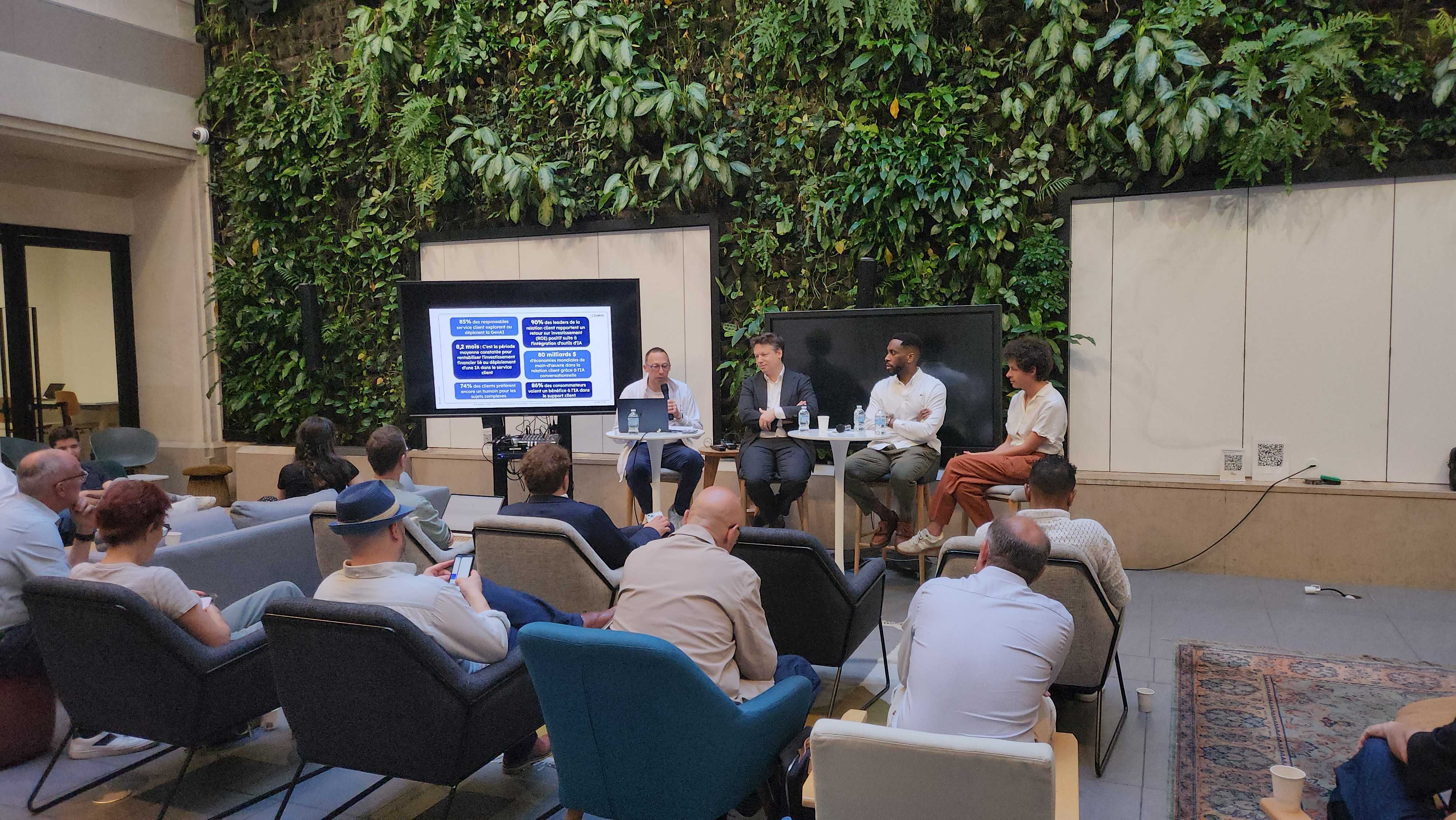
Month after month, AI has woven itself into the fabric of business, transforming daily operations. But what about human connections, and specifically customer relationships? Beyond the grand promises and attractive statistics, what is actually happening on the ground?
Valentin Drouet, our Head of Customer Success, Eleazar Baptiste, Head of App Management (RingOver), and Michaël Pudlowski, Digital & Customer Partner (KPMG), explored this topic during a panel discussion at our latest AI Breakfast.
When we talk about AI in customer service, we often immediately picture the classic front-office chatbot that customers interact with to ask questions.
But what if the most powerful transformation is actually happening in the back office, supporting sales and customer success teams?
In fact, conversational analysis—AI that listens to, transcribes, and understands customer calls—is rapidly becoming the standard.
In practical terms: automated CRM entry updates customer records after a call; real-time insights prompt agents with the right rebuttals; and call libraries are used to train new hires using real-world scenarios.
The result: teams spend less time at their keyboards and more time building relationships.
An example shared by Michaël Pudlowski illustrates this impact: a small online brokerage firm used to employ 10 people just for call monitoring (a regulatory requirement in insurance). With AI, they now monitor 100% of calls instead of 30%, and have redeployed those 10 full-time employees to higher-value tasks.
Perhaps one of the biggest impacts of AI on customer relations is that customers now arrive at an agency with a ChatGPT conversation open in another tab. They know—or think they know—their contract better than the advisor. In insurance or banking, that creates a complex dynamic.
Add to this the security and integration constraints for companies that sometimes find themselves with "in-house" AI solutions that are inferior to the consumer tools available to their customers, leaving the door wide open to shadow AI.
One might assume that customers insist on speaking with a human advisor, do not trust AI agents, or that using this technology could damage a company's reputation.
In reality, public opinion appears to be much less polarized than one might imagine.
A recent KPMG customer experience study reveals that what customers want above all else is efficiency, access to an advisor when needed, the fastest possible refunds, and quick answers…
4 out of 5 customers are happy to use a chatbot for simple needs, provided the response is fast and consistent. As soon as complexity increases or the issue becomes critical (telecom outages, insurance claims), the customer wants a human. AI doesn't replace the agent; it redefines their role.
It is, in fact, simply a means to satisfy a growing need for immediacy.
This is arguably one of the most impressive transformations of the coming years.
Four types of agents now coexist:
The unique feature of the latter two is that they no longer just provide information: they act for you. They navigate, filter, purchase, dispute, and request refunds. The customer still makes the final purchase, but they are no longer the one clicking. This is what we call Business to Agent to Client.
Within three years, 15% to 30% of customer journeys could be handled by these agents.
Traditional KPIs—time spent on site, conversion rates, page views—will gradually lose their relevance.
Today, there is no shortage of successful use cases and examples of AI's great potential, making it tempting to jump in as quickly as possible. However, be careful not to confuse evolution with haste. Our three panelists discussed the main pitfalls to avoid:
If you would also like to improve efficiency in your customer relations, contact our experts.