Trusted AI
·
October 13, 2026
Which ROI-focused AI should you choose for your business in 2026
How much does it cost to implement internal AI? Find out in our latest article!

Artificial intelligence is gaining ground in the workplace, but for it to be truly useful, one condition is essential: you must be able to trust its answers.

AI is becoming increasingly widespread, both in our personal and professional lives.
However, for it to be truly useful in a professional setting, it is crucial to be able to trust the information provided and to receive clear, verifiable, and accurate answers.
A single wrong answer can be enough to undermine trust in an AI tool, and not all models are created equal. Some can produce erroneous or inconsistent responses, a phenomenon often called "hallucination." In a professional context, this can lead to complex situations that may negatively impact a company's credibility and reputation.
And the impacts are far from trivial: incorrect financial advice can cost thousands of euros, a report filled with false data can lead to poor strategic decision-making, and an article containing inaccurate facts can ruin a brand's credibility...
These are all errors that damage a company's reputation, wasting time and compromising the reliability of the tools used by employees.
AI agents used in a professional setting must be reliable and verifiable to guard against these flaws, which can shake an entire organization.
Traditionally, an AI conversational agent generates its responses based on the knowledge it acquired during its training. However, this data can be outdated or inaccurate.
The best solution to ensure the agent relies on accurate data is to provide it ourselves!
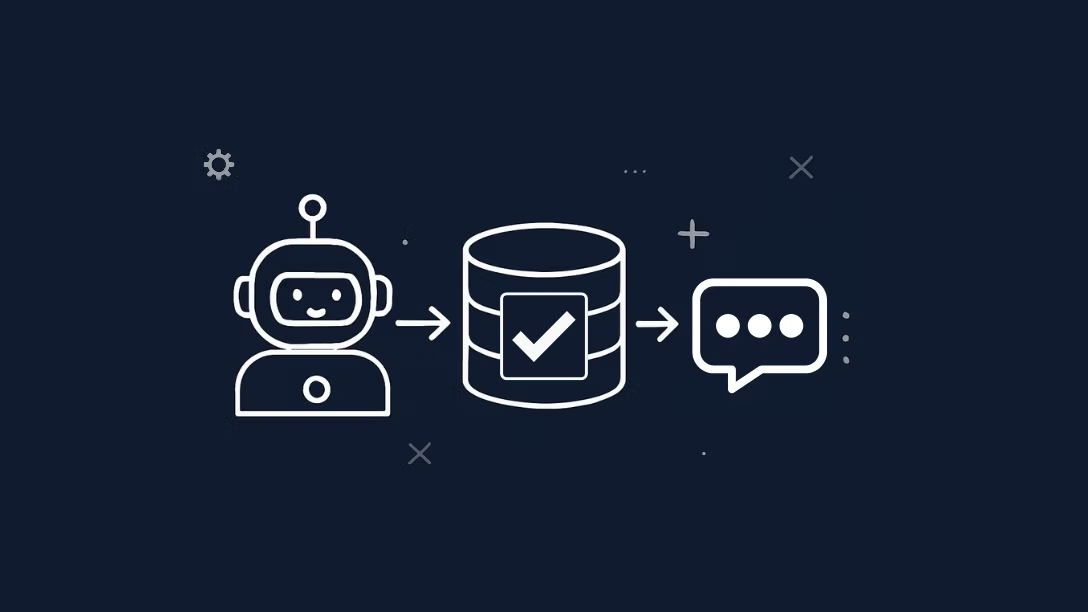
This is known as the RAG (Retrieval Augmented Generation) method. We provide the AI with a database derived from internal documents, but that's not all. It can also draw on reliable external sources (open data, official publications, APIs, etc.) to provide answers that are both accurate and up-to-date. The key is to control the sources the AI is authorized to query.
The AI no longer relies solely on its own knowledge, but queries a database or a set of reference documents provided by the company. The result: instead of inventing information, the AI bases its answers on real sources, which reduces the risk of errors or "hallucinations."
In addition to enabling the AI to provide reliable information, the RAG method offers other advantages:
One of the reasons AI agents provide incorrect information is their “obligation” to always provide an answer (even if it is wrong). In short, AI doesn’t know how to say “I don’t know” or “I’m not sure.” With the RAG method, this limitation can be overcome.
Since the agent searches for its answers within a defined document base, it can recognize when no relevant source exists and, in that case, refuse to answer or indicate that it cannot find the information. An agent capable of “refusing” to provide an answer is therefore much more reliable.
At Craft AI, we believe that AI agents must meet four criteria:
Want to deploy an AI agent you can trust? Contact our experts