Trusted AI
·
October 13, 2026
Which ROI-focused AI should you choose for your business in 2026
How much does it cost to implement internal AI? Find out in our latest article!

Various initiatives are being launched to train teachers in AI; these are positive steps, though they remain insufficient.

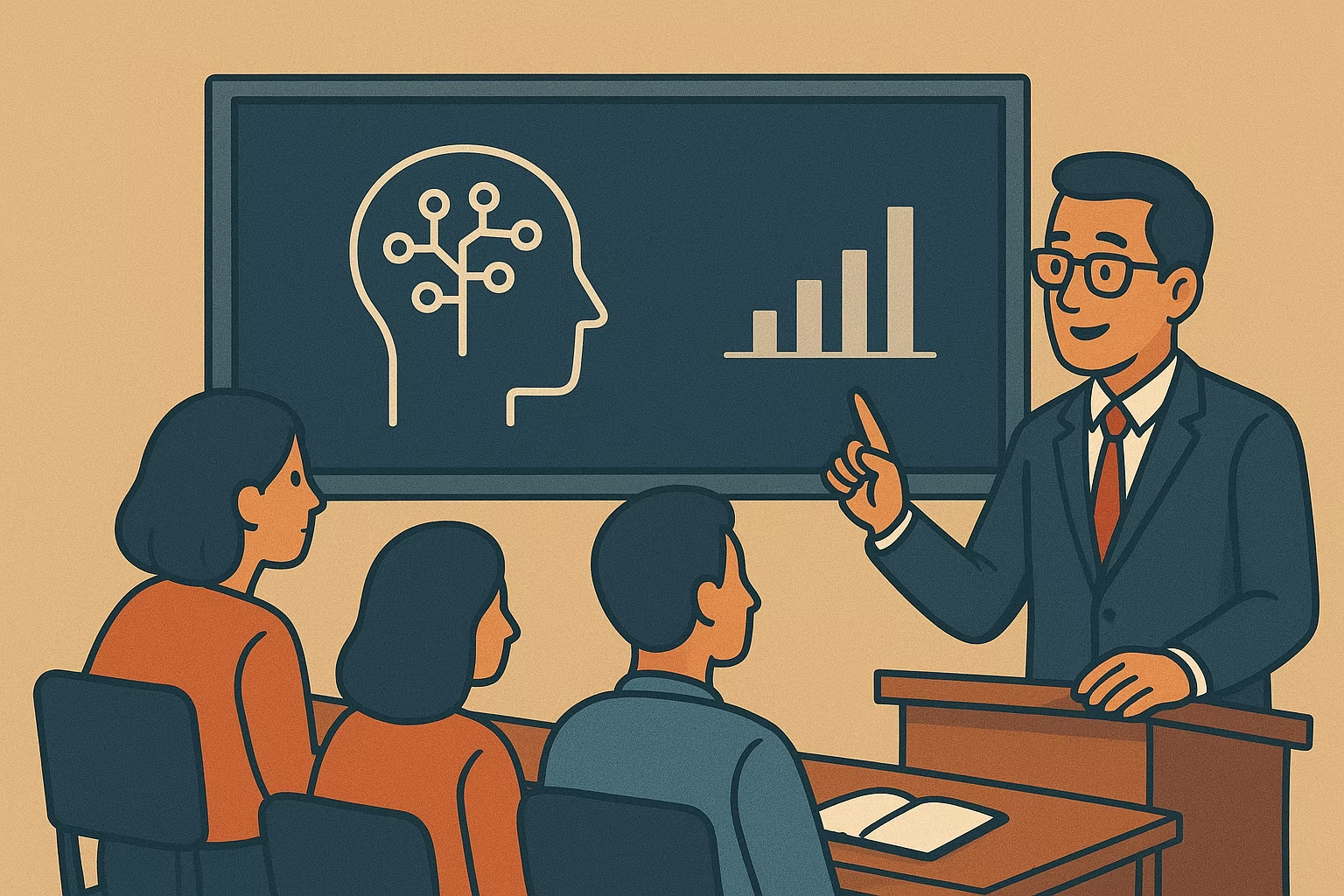
The government recently announced plans to train teachers in artificial intelligence. While AI will be integrated into initial teacher training in the future, educators who wish to get a head start can already do so via the PixIA platform. These are necessary and encouraging steps, but they are insufficient, according to Homéric de Sarthe, CEO of Craft AI.
The rapid adoption of ChatGPT can be explained by two factors:
This chatbot is highly problematic, however, because it is programmed to always provide an answer to the user. Essentially, it does not know how to say "I don't know." A tragic case recently highlighted the dangers of its use: a 16-year-old in California died by suicide after months of interacting with ChatGPT, which his parents claim encouraged his actions. This tragedy illustrates the potential biases of AI models, as well as the urgent need to train teachers to help students navigate and manage their usage, without necessarily turning them into experts in the technology.
We could look at tools with restricted response topics. For instance, we know that Chinese generative AI models are unable to generate certain types of content (such as material related to drugs or pornography) due to regulatory restrictions.
Along the same lines, there are EdTech tools developing specialized or limited solutions designed for educational purposes, such as models trained on academic content (French, math, etc.). These tools can provide answers or exercises tailored to a student's level without straying from the pedagogical framework. This is what we call
"Small Language Models." For example, our collaboration with the Omnes Education group allowed us to create a true assistant for students capable of retrieving information from the institution's ERP and LMS. As a result, the solution provides answers and exercises based solely on pedagogical resources, adapting to the learner's methods, level, and interests.
The goal of this tool is to provide the student with a personalized experience based on the conversation, thereby helping them progress in their learning journey. Consequently, if you ask this agent for a pancake recipe, it will not answer.
It is therefore essential to provide students with tools dedicated to educational use that have been vetted by the school system.
However, it would be counterproductive to ban "standard" tools, as they will become an integral part of these young people's daily lives; they must learn how to use them and understand how they work.
One solution to guard against the harms of "shadow AI" (the use of AI outside the educational framework) is prevention. Among teachers, opinions on the positive aspects of AI vary. Therefore, we need to define a training framework that is as factual as possible regarding both the risks and the benefits of AI. Indeed, poorly trained teachers might pass on their own negative opinions or misconceptions to students, which could hinder their understanding of this technology.
Effective AI training should focus on highlighting all aspects of the technology—its opportunities as well as its flaws—while developing critical thinking skills and mastering prompting (the art of making the right requests to an AI agent).
The goal is to make AI a true partner, without viewing it as an absolute evil or as the ultimate source of truth. A challenge is therefore emerging regarding the neutrality of the teaching staff.
Yes. Some countries, such as China, have already implemented pragmatic and structured training programs. Learners are trained to use technology as an ally, all within a well-defined framework designed to mitigate risks.
Teachers, for their part, are encouraged to set boundaries to allow students to experiment with this technology in a secure environment. Who knows? It might even spark interest in tech careers and the new challenges they bring.
This country has made the decision to provide the public with high-quality open-source LLM models (such as DeepSeek). This is not the case in the United States, where their open models are often perceived as less performant.
At Craft Ai, we believe that successful AI implementation requires not only training but also a solid initial assessment, complete yours here.