Trusted AI
·
October 13, 2026
Which ROI-focused AI should you choose for your business in 2026
How much does it cost to implement internal AI? Find out in our latest article!

HR procedures, product sheets, company policies... Internal documentation quickly becomes essential for every employee. But as a company grows, procedures pile up, and accessing the right information becomes a real challenge.

Large corporations, franchises, and groups with subsidiaries all face the challenge of uniting multiple locations—and the many employees that come with them. How can you ensure information flows smoothly between headquarters and the field? Discover how AI can standardize and secure access to information for your teams.
For many companies, accessing information is a real headache.
The larger the structure, the more internal communication challenges arise…
And as internal documentation becomes increasingly dense, it must be able to address several challenges:
This is where the internal documentation "repository" system must be high-performing. Often, employees know the information exists but don't know where to find it, and can sometimes feel overwhelmed by the sheer volume of available data.
To overcome this issue, every company has its own solution:
But by asking a public AI to summarize a confidential memo, employees expose the company to data leaks and the loss of intellectual property.
As we have seen, the use of AI is becoming increasingly widespread in companies, and bringing it in-house would be a game changer.
All teams could have access to the same information, without wasting time and within a secure framework.
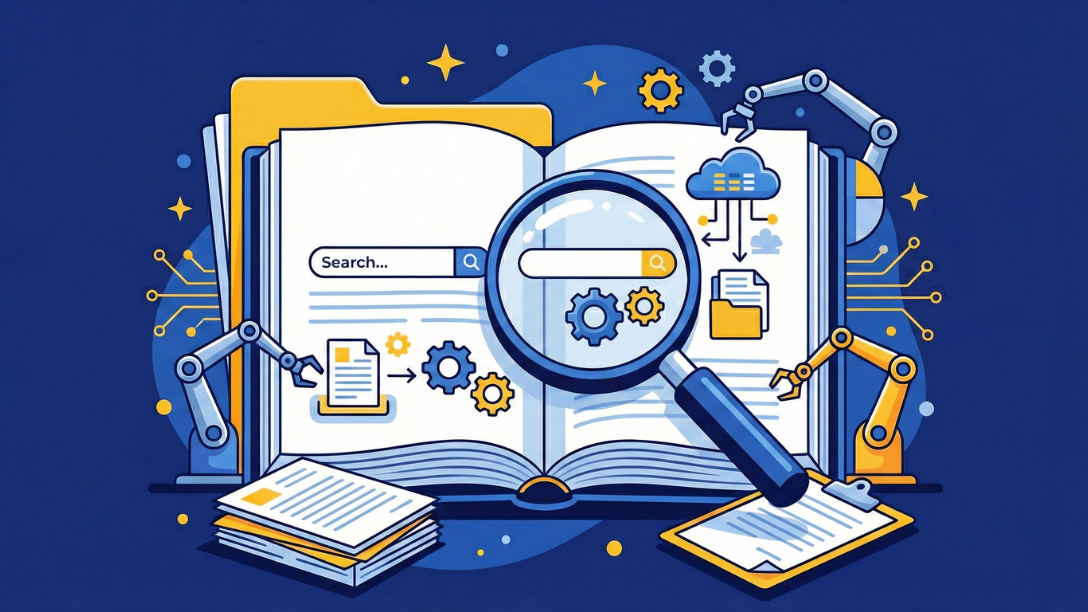
To ensure the AI provides the right information to the employee, we provide it with a pre-validated document base to draw from.
The documents in this base are broken down and transformed using a specific AI model (embedding) to make them "readable" by the system, which then analyzes and categorizes them to understand the "deep" meaning of the ideas they contain, rather than just keywords.
When a question is asked, it is transformed in the same way.
The system then simply searches for semantically similar elements within the pre-provided database.
The question and this set of documents are then sent to an LLM, which is capable of providing a well-founded, structured response in "human" language.
The information is structured, clear, and easily and quickly accessible, much like an internal search engine.
You have the documents, we have the technology to make them talk. Let's discuss your growth challenges and build your custom solution, contact us!