Trusted AI
·
October 13, 2026
Which ROI-focused AI should you choose for your business in 2026
How much does it cost to implement internal AI? Find out in our latest article!

In this second episode of our mini-series, learn how to decode the technologies that power AI

Understanding artificial intelligence is good. But knowing what makes it work is even more strategic for getting the most out of your data.
Behind every application, chatbot, or recommendation engine lie powerful technologies that transform raw data into applied intelligence.
This second part of the AI glossary explores the key concepts and technologies that power AI:
A program capable of interacting with a human, whether in the form of a chatbot, voice assistant, or virtual agent. Thanks to advances in Natural Language Processing (NLP), these tools can understand intent, respond coherently, and learn from interactions. They are increasingly used in customer service, citizen support, and internal business management. The goal is to make communication between humans and machines more fluid and natural.
A mechanism that allows a model to focus on the most relevant elements of a piece of data (for example, specific words in a sentence). This principle improves context comprehension and the quality of the results produced. Introduced in modern architectures like Transformers, it is the foundation of generative AI models such as GPT. In short, it helps AI "sort through" information to reason more effectively.
An error backpropagation algorithm, essential for training neural networks. It gradually adjusts the model's internal parameters to reduce the gap between predictions and expected results. This iterative process allows the AI to improve after each analyzed example. It is one of the pillars of modern deep learning.
A set of technologies that allow for the storage, processing, and deployment of AI models on remote servers. The cloud provides the flexibility needed to manage large amounts of data and perform heavy computations without local infrastructure. It makes AI accessible, scalable, and collaborative, while optimizing deployment costs.
A machine learning technique based on multi-layered neural networks capable of extracting complex data representations. It is particularly effective for processing images, audio, or language. Thanks to deep learning, AI can recognize faces, translate texts, or generate content. This approach is now at the heart of major breakthroughs in artificial intelligence.
A compact numerical representation of a word, image, or concept. It transforms complex information into mathematical vectors that models can manipulate. Embeddings capture semantic relationships; for example, the words "king" and "queen" will have similar representations. They are essential for linking data together and facilitating contextual understanding.
The process of adjusting a pre-trained model using data specific to a particular use case. This allows a general-purpose AI (like GPT) to be specialized for a specific field, such as healthcare, law, or public administration. This method reduces training costs and improves the relevance of results. Fine-tuning is now a key practice for adapting AI to concrete needs.
A massive language model trained on vast text corpora to understand, complete, or generate text fluently. LLMs like GPT, Claude, or Llama have revolutionized access to information and productivity. Their strength lies in their ability to synthesize, rephrase, and reason based on natural language. However, their power also raises ethical and reliability concerns.
A branch of artificial intelligence dedicated to understanding and generating human language. NLP enables a machine to analyze texts, answer questions, translate, or detect emotions. It combines linguistics, statistics, and machine learning. This discipline is the foundation for virtual assistants, intelligent search engines, and automatic summarization tools.
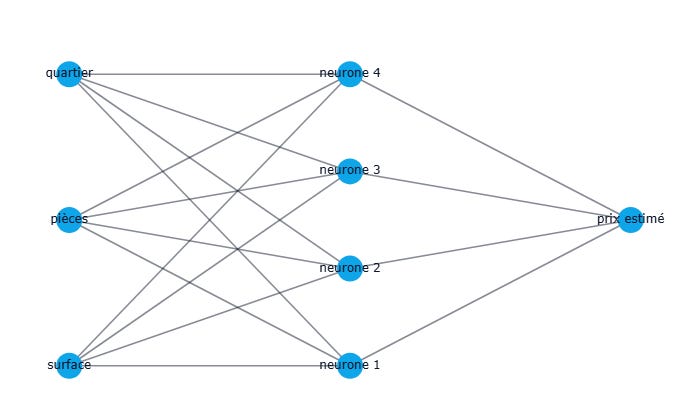
A mathematical structure inspired by the human brain, composed of layers of interconnected artificial neurons. Each neuron processes a portion of information and transmits its result to others. Neural networks are the basis of deep learning and allow models to learn complex relationships within data. Their architecture determines the nature and performance of the model.
The process of breaking down text into elementary units called "tokens," such as words, syllables, or sub-words. This step allows the artificial intelligence model to understand and process language in a usable numerical format. Effective tokenization improves context understanding, response coherence, and the accuracy of natural language processing (NLP) models. It is an essential building block in preparing textual data.
Internal model variables adjusted during training to optimize performance. Each parameter influences how the AI perceives data and makes decisions. Modern large-scale models can contain billions of parameters, giving them exceptional learning power. Proper tuning is essential to ensure stability, accuracy, and reliability.
A structured set of steps for an artificial intelligence project, from data collection and cleaning to model deployment. Each phase (preparation, training, validation, production) contributes to the quality of the final result. A well-designed pipeline ensures an AI that is reproducible, transparent, and maintainable over time.
Text or a command used to guide an artificial intelligence's generation or response. A well-formulated prompt directs the model to produce a relevant and targeted response. The quality of a prompt directly influences the quality of the result obtained. It is a key element of interacting with generative models.
The practice of designing, formulating, and optimizing prompts to get the most out of models
An artificial intelligence technique that combines text generation with information retrieval from a knowledge base. Before formulating a response, the model first identifies and extracts relevant documents, which it then uses to produce content that is more accurate, coherent, and grounded in real facts. This approach enhances the reliability of generative models, particularly in fields where factual accuracy is essential, such as customer support, technical documentation, or research.
A key architecture for modern generative AI, introduced in 2017, which relies on an attention mechanism to efficiently process large amounts of text. Transformers have enabled dramatic breakthroughs in NLP and have given rise to models like GPT, BERT, and T5. Their design facilitates parallel learning, which significantly accelerates computation.
The process of converting data (text, images, sound) into numerical vectors that AI models can use. This step enables the mathematical processing of unstructured information. By transforming language or images into numbers, vectorization builds a bridge between the human world and the world of machines. It is essential to every stage of machine learning.
Ready to see what your data is really trying to tell you? Let our experts help you find out. Contact us today
To download your full copy of our glossary, head over here !