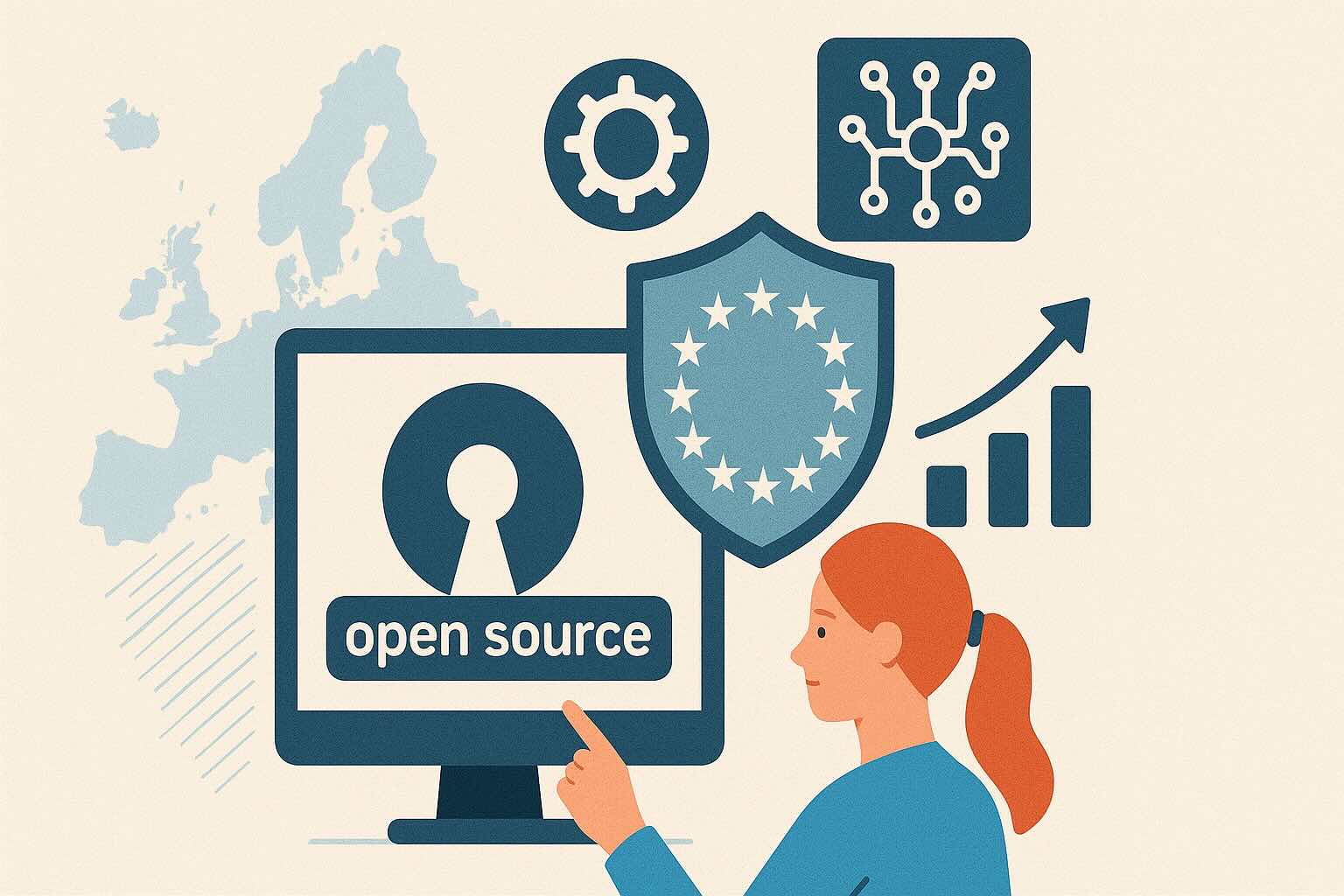
The AI landscape is defined by the announcement of new models that are increasingly powerful, expensive, and closed. The race for performance is in full swing, driven by a few American and Chinese tech players who now concentrate the bulk of innovation. Faced with this dynamic, Europe has yet to find its path. It oscillates between technological fascination and growing dependence. Yet, a credible and sustainable alternative exists: open source.
This choice is neither marginal nor naive. It is now emerging as a strategic lever for building an artificial intelligence that is more sovereign, more agile, and better aligned with the realities of European businesses.
A concrete response to the challenges of sovereignty and agility
Too often, open source is still perceived as a free or community-based solution. In reality, it is a genuine industrial asset. Adopting open models allows you to maintain control over your deployments, adapt models to your specific business needs, and, above all, ensure transparency regarding how they function.
Conversely, proprietary models expose organizations to constant instability: pricing changes, usage restrictions, dependence on commercial APIs, and a lack of visibility into model evolution. A company that invests heavily in a single provider risks having to readjust its entire strategy at the slightest change.
At a time when AI innovations are happening in rapid succession, developing true technological autonomy is essential. This requires model-agnostic platforms capable of facilitating the transition between different models, allowing for an easy shift from a proprietary model to an open one, and from one provider to another.
Performance, cost control, and confidentiality
Open-source language models have progressed rapidly in recent months, to the point where their performance is converging with proprietary solutions across many use cases. Above all, they allow companies to make informed technical trade-offs: hosting a small model locally or in a trusted cloud, or occasionally accessing a more powerful model via API. This hybridization opens up a new field of possibilities.
It also addresses a central challenge: data protection. Building an application based on open-source models deployed in-house guarantees the confidentiality of sensitive data, without reliance on third parties. This meets both regulatory requirements and growing expectations regarding ethics and cybersecurity.
Another key advantage is cost management. Unlike API solutions that charge per request or token, an open-source model allows you to shift from variable costs to controlled fixed costs, which is particularly advantageous at scale.
Open source: a driver for frugal and targeted AI
In a context of energy constraints and digital sobriety, it is no longer feasible to mobilize massive models for simple tasks. Open source encourages the use of more compact, specialized models that are well-trained on business datasets, reducing both carbon footprint and technical debt.
These small language models (SLMs) make it possible to build leaner, more targeted AI agents to automate numerous tasks, such as generating documents, retrieving information from a database, or sending emails. Their low resource consumption facilitates deployment across diverse environments and also enables use on embedded devices.
Building a credible European alternative
Europe has the talent, resources, regulations, and ecosystem to forge its own path in AI. However, this requires making open source a priority political and economic project. Because beyond sovereignty, it is our long-term capacity for innovation that is at stake.
By supporting open-source initiatives, investing in AI agent development platforms, and focusing on trusted infrastructure, Europe can regain control in the global AI race. It can do so on its own terms: with transparency, control, and ethical commitment.
The artificial intelligence of tomorrow should not be about raw power. It must be efficient, adaptable, frugal, transparent, modular, and interoperable, in direct alignment with the concrete needs of businesses and users.