Key points: European alternatives to ChatGPT
- European alternatives to ChatGPT allow companies to keep their data within the EU, out of reach of the US Cloud Act.
- Open-source models like Llama or solutions from Mistral AI offer the possibility of full self-hosting on your own servers.
- Craft AI supports French companies in industrializing sovereign AI solutions, with 360° monitoring and cost control.
- The GDPR and the European AI Act impose strict requirements that US solutions cannot structurally guarantee.
- Self-hosting requires internal MLOps expertise and dedicated GPU infrastructure, but it eliminates any exposure to foreign jurisdictions.
Why European companies are looking for alternatives to ChatGPT
You are likely already using generative AI tools in your organization. ChatGPT has democratized access to large language models, but its use in a professional context raises major legal questions for French and European companies.
The first obstacle concerns jurisdiction. OpenAI is a US company, and all data passing through its APIs is subject to US law. The Cloud Act (18 U.S.C. §2703) allows US authorities to demand access to data held by US companies, regardless of where it is hosted.
For legal departments and DPOs, this legal reality creates a compliance risk that is difficult to manage. Even if OpenAI offers a GDPR-compliant data processing agreement, no contractual arrangement can override a US court order.
What is a European alternative to ChatGPT?
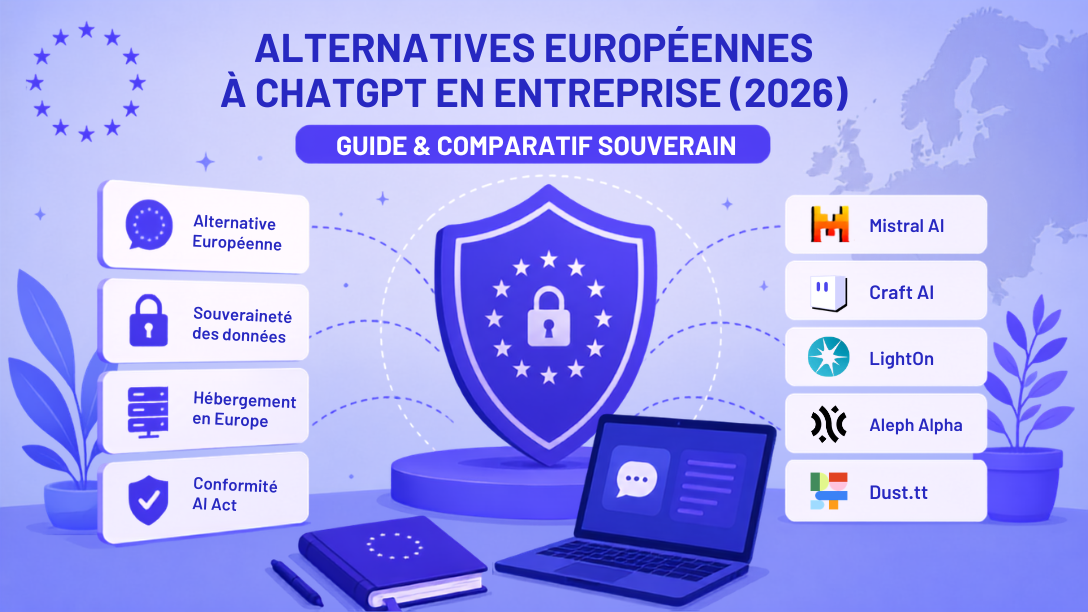
A European alternative to ChatGPT refers to a conversational AI solution developed or hosted in Europe, designed to meet the territory's regulatory requirements. These solutions are distinguished by three main characteristics.
The first is data residency. Your information remains stored on servers located in the European Union, under European jurisdiction. The second concerns native GDPR compliance. These platforms integrate personal data protection principles from the ground up. The third relates to the explainability and auditability of the models used.
Some solutions go further by offering full self-hosting. You then deploy the model on your own infrastructure, and no data leaves your controlled environment.
Digital sovereignty challenges for French companies
Digital sovereignty is not an abstract concept. It represents your organization's ability to maintain total control over its strategic data and critical digital tools.
According to several industry studies, 72% of European companies state that they do not wish to store their data in the United States due to the Cloud Act. This concern is particularly pronounced in regulated sectors: banking, insurance, healthcare, defense, and public administration.
For these organizations, the issue is not just technical. It touches on the trust of customers, partners, and regulators. Demonstrating that your AI processing remains under European jurisdiction is becoming a competitive advantage.
The Cloud Act and its practical implications
The U.S. Cloud Act, passed in 2018, authorizes U.S. government agencies to request access to data held by U.S. companies, even if that data is stored outside the United States. This law applies regardless of encryption or contractual confidentiality clauses.
For a European company using ChatGPT Enterprise, this means that its data could theoretically be subject to access requests by U.S. authorities. The EU-U.S. Data Privacy Framework does not cover this scenario.
How the GDPR and the AI Act govern the use of AI in business
The European regulatory framework imposes specific obligations on organizations that deploy AI systems. The GDPR requires a legal basis for all personal data processing, clear information for the individuals concerned, and the ability for them to exercise their rights.
TheAI Act, the European regulation on AI, which has been progressively implemented since 2024, adds specific requirements based on the risk level of the systems. General-purpose AI (GPAI) models must comply with transparency and technical documentation obligations.
For companies in the financial and insurance sectors, the DORA regulation also imposes digital operational resilience requirements that directly affect the AI tools used in production.
What the AI Act requires from LLM providers
Providers of general-purpose AI models must now document their training processes, comply with copyright obligations, and implement systemic risk management measures for the most powerful models.
For you as a professional user, this means you must ensure that your AI provider is in compliance with these new obligations. European solutions, developed within this regulatory context, integrate these requirements natively.
What criteria should you use to choose a European alternative to ChatGPT?
Choosing a conversational AI solution for your company depends on several technical and organizational criteria. Here are the essential points to evaluate.
Data location and jurisdiction
Verify where your data is physically hosted and under which jurisdiction. Hosting in France or the EU, with a European cloud provider, protects you from the Cloud Act. Some solutions offer hosting on your own infrastructure (on-premise) for total control.
Business model and transparency
Distinguish between proprietary models (closed source) and open-source models (accessible code and weights). Open-source models allow for a full audit of their operation and advanced customization. Proprietary models often offer superior performance on certain tasks but with less visibility into their internal workings.
Integration and industrialization capabilities
Evaluate compatibility with your existing ecosystem. Is the API compatible with market standards? Can you connect your internal data sources (Sharepoint, Notion, business databases)? Craft AI offers an industrialization platform that allows you to deploy AI agents connected to over 100 services, while keeping your data in a secure environment.
Monitoring and governance
The ability to track usage, costs, and the quality of your AI's responses is essential for a successful production rollout. Look for features like audit trails, user or group permission management, and end-user satisfaction analytics.
Top European AI solutions for businesses
The European market offers several credible alternatives for organizations looking to deploy generative AI within a sovereign framework. Here is an overview of the available approaches.
| Solution |
Pays / Origine |
Type de déploiement |
Point fort principal |
| Mistral AI (Le Chat / API) |
🇫🇷 France |
SaaS / Cloud UE / On-premise |
Performances au niveau du SOTA mondial |
| LightOn (Paradigm) |
🇫🇷 France |
SaaS S3NS / On-Premise |
Spécialisé entreprises & RAG souverain |
| Aleph Alpha (Pharia) |
🇩🇪 Allemagne |
Cloud UE / On-premise |
Transparence & explicabilité avancée |
| Dust.tt |
🇫🇷 France |
SaaS UE |
Orchestration d'agents et connexion SI |
| Craft AI |
🇫🇷 France |
Cloud Souverain / Hybride |
Orchestration d'agents, Spécialisé entreprises |
Open-source models for self-hosting
Open-source models like Llama (Meta) or community versions of Mistral can be deployed on your own infrastructure. This approach gives you total control: no data leaves your servers, and you can audit the model's code.
However, self-hosting requires internal MLOps expertise and dedicated GPU infrastructure. For companies that lack these resources, platforms like Craft AI simplify the deployment of open-source models on the cloud of your choice, including sovereign clouds certified HDS and SecNumCloud.
European SaaS solutions
Several European vendors offer SaaS platforms hosted within the EU. These solutions provide a balance between ease of deployment and data control. Your information remains within European territory but is processed by a third party.
For regulated sectors (banking, insurance, healthcare), check the provider's certifications: ISO 27001, HDS for health data, and DORA compliance for the financial sector.
The hybrid approach: flexibility and control
Some platforms allow for a hybrid approach combining cloud and on-premises infrastructure. For example, you can host sensitive data on your own servers while using cloud GPU resources for model inference.
This flexibility allows you to adapt your architecture to the specific constraints of each use case. Craft AI offers this technological independence by letting you choose your host from among sovereign clouds (Scaleway, S3NS, NumSpot) or hyperscalers.
How to deploy a European AI solution in your organization
Moving to a European alternative to ChatGPT involves several steps. This transition can be gradual and does not require changing everything overnight.
Step 1: Map your current use cases
First, identify how generative AI is being used within your organization. According to several studies, Shadow AI—the use of AI tools without IT department approval—affects 68% of companies. Mapping this out will help you prioritize high-impact use cases.
Step 2: Define your security requirements
Not all use cases have the same constraints. For generating marketing content, a European SaaS solution may suffice. For processing confidential data (contracts, client files, health data), self-hosting will likely be necessary.
Step 3: Evaluate the total cost of ownership
The cost of an AI solution goes beyond just the license. Include the following in your analysis: team training, integration with your existing tools, the necessary infrastructure (GPUs for self-hosting), and the engineering time required for deployment.
For large corporations with a structured IT department, the additional integration cost remains marginal. For SMEs, working with a partner specializing in AI industrialization can accelerate implementation and reduce risks.
Step 4: Pilot and iterate
Start with a pilot project on a limited scope before scaling up. Measure key indicators: user adoption, response quality, and time saved on repetitive tasks. These metrics will allow you to justify the investment and adjust your approach.
What are the use cases for European AI in business?
European conversational AI solutions meet the same needs as ChatGPT, with the added advantage of data sovereignty. Here are the most common use cases in business.
Document research and summarization
Query your internal document databases (reports, contracts, procedures) using natural language. The AI identifies relevant information and produces structured summaries. This use case is particularly well-suited for legal departments, compliance teams, and business units that handle large volumes of documents.
Automation of repetitive tasks
Generating template emails, rephrasing content, translation, and extracting structured information from unstructured documents: these low-value tasks can be delegated to AI, allowing your teams to focus on analysis and decision-making.
Customer support and internal helpdesk
An AI assistant trained on your FAQs and documentation can answer recurring questions from your customers or employees. This approach reduces the burden on support teams while maintaining 24/7 availability.
Predictive maintenance and industrial optimization
In the industrial sector, AI analyzes sensor data to anticipate breakdowns and optimize production processes. Craft AI supports industrial companies in deploying predictive maintenance and quality control solutions, with full control over production data.
The challenges of industrializing AI projects
Moving from prototype to production is the main hurdle for corporate AI projects. The statistics speak for themselves: 74% of AI projects fail to achieve sufficient performance in real-world conditions to be adopted by users.
Scaling up
An AI assistant that works well for a few users may encounter performance, cost, or reliability issues when deployed at scale. The technical architecture must be designed from the outset to handle increased loads.
Cost control
Inference costs for large language models can quickly exceed projected budgets. Rigorous FinOps management, with real-time consumption tracking and infrastructure optimization, is essential to maintain project profitability.
The Craft AI platform integrates FinOps tools that allow you to precisely visualize costs by model, use case, and user. This visibility helps identify potential optimizations and significantly reduce cloud costs.
Preventing hallucinations
Language models can generate factually incorrect responses with an appearance of certainty. This phenomenon, known as hallucination, poses a major risk for professional use cases where information reliability is critical.
360° monitoring allows you to evaluate the relevance and accuracy of every response. RAG (Retrieval Augmented Generation) mechanisms anchor AI responses in your verified data, reducing the risk of hallucinations.
Conclusion: how to succeed in your transition to sovereign AI
European alternatives to ChatGPT are no longer just a technological curiosity. They represent a mature option for companies that want to benefit from generative AI while maintaining control over their data and complying with the European regulatory framework.
The choice between self-hosting, European SaaS, or a hybrid approach depends on your specific constraints: industry, sensitivity of the data processed, available technical resources, and budget. The key is to clearly define your requirements before selecting a solution.
For organizations just starting out, beginning with a limited use case allows you to validate the approach before scaling. For those with existing AI projects, a gradual migration to sovereign solutions can be considered as contracts come up for renewal.
Craft AI supports French and European companies in this transition, from needs analysis to team training, with a platform designed for industrializing AI within a trusted framework.
FAQ on European alternatives to ChatGPT
Are European alternatives to ChatGPT just as effective?
For common business use cases (summarization, writing, Q&A, document analysis), European solutions offer comparable performance. Open-source models like those from Mistral or Llama reach quality levels suited to professional needs. Craft AI allows you to choose from the models available on the market and easily switch between them according to your needs.
How does the cost of a European AI solution compare to ChatGPT?
Pricing varies depending on the deployment model chosen. European SaaS solutions offer prices comparable to ChatGPT Team or Enterprise. Self-hosting requires an initial investment in GPU infrastructure but can reduce long-term costs for intensive use. Craft AI offers organization-based pricing rather than per-user pricing, which can generate savings for large teams.
Is it easy to migrate from ChatGPT to a European alternative?
Migration is generally seamless because most European solutions offer APIs compatible with the OpenAI standard. Your existing technical integrations can often be adapted with minor modifications. The Craft AI user interface is designed to be intuitive, which facilitates team adoption.
Is self-hosting mandatory to ensure data sovereignty?
No. SaaS hosting with a European provider, on servers located in the EU and operated by a European entity, already provides protection against the U.S. Cloud Act. Self-hosting provides an additional level of control but is not essential for all use cases. Craft AI offers the flexibility to choose your sovereign cloud.
How can you ensure a solution is compliant with GDPR and the AI Act?
Verify that the provider is a European legal entity subject to EU law. Request security certifications, the Data Processing Agreement (DPA), and technical documentation regarding compliance measures for the AI Act. An integrated audit trail and traceability features also facilitate preparation for regulatory audits.


_Craft%20AI.jpg)