Trusted AI
·
October 13, 2026
Which ROI-focused AI should you choose for your business in 2026
How much does it cost to implement internal AI? Find out in our latest article!

Discover the 8 essential criteria for evaluating and choosing a secure, sovereign, and seamlessly integrated enterprise AI agent platform.

Businesses are finally moving beyond the discovery phase of artificial intelligence. After testing various simple conversational assistants, technical and business teams are now looking to take the next step: integrating AI directly into their daily tasks.
An AI agent goes further than a simple chat tool. It reads your internal documents, operates according to your business rules, and performs operational actions within your software itself. Choosing the right platform to create and manage these assistants is essential for the success of your digital transformation without wasting time or money.
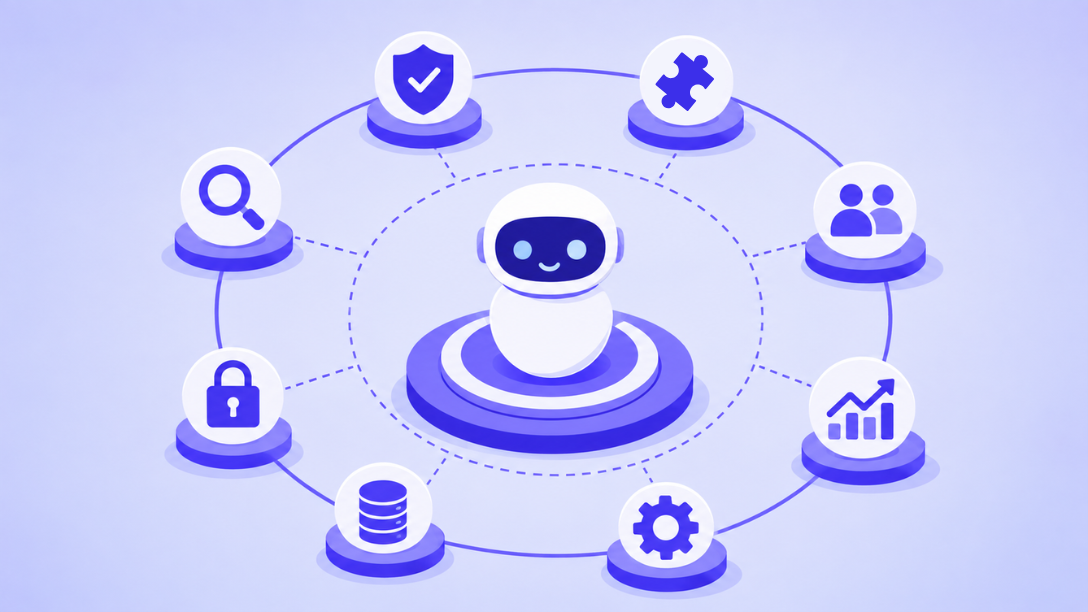
Here are eight concrete criteria to help you compare solutions and succeed in the deployment and selection of your AI agents within your company.
This is the golden rule of any IT project: your confidential information must stay "in-house." Whether it's client contracts, HR files, or sales figures, nothing should leak.
For anyenterprise AIproject, the platform must let you choose where your data is stored. You should be able to host your tools on French or European servers, or directly on your own computers. The solution must comply with data protection laws and guarantee that your documents will never be used to train other companies' artificial intelligence.
The world of artificial intelligence is moving very fast. The most powerful tool today will likely be replaced by a faster or cheaper one in a few months.
To avoid being locked in with a single provider, choose a neutral platform. It should allow you to change the "engine" of your business AI agents very easily, in just a few clicks. This way, you can use the best technologies available at any given time without having to overhaul how your assistants work.
A virtual assistant that works in a silo and cannot communicate with your other programs won't save you much time. It only becomes truly useful once it "hooks into" your other work tools.
Business process automation requires the agent to be able to read and write information where you already work: your CRM, your payroll software, or your shared folders. The assistant must be able to retrieve a document, find an answer within it, and update your company files autonomously.
To provide accurate answers, your AI assistant must know your company inside and out. It shouldn't guess or make things up, but rather rely solely on your fact sheets, procedures, and the documents you have provided.
Before choosing a solution from the AI agent creation tools, check how it handles your documents:
If the search within your files is poor, the assistant will make mistakes.
Testing an assistant on two or three documents costs almost nothing. But when dozens of employees use it all day long, the computing bill can quickly climb.
A platform designed for professional use should clearly show you what each project consumes. Prioritize solutions that offer energy savings, such as automatically putting tools into sleep mode when no one is using them. This way, you maintain total control over your budget.
A successful AI project brings together two types of people: the IT specialists who set up the infrastructure and the field teams who will use the tool on a daily basis.
The ideal platform offers comprehensive tools for developers while remaining simple for operational teams to use. If the solution provides pre-built agent templates for accounting, customer service, or human resources, you will save valuable time during launch.
Giving autonomy to a software program requires setting very precise boundaries. An assistant must not be able to read information that its user does not have access to.
The platform must allow you to fine-tune permissions. For example, a recruiter should not be able to view the company's bank details.
Also, require a log that records every action taken by the agent. If an error occurs, you must be able to review the history to understand what happened.
Once your assistants are in place, the work has only just begun. You must regularly verify that they are actually helping users and that the quality of their responses remains high.
A good platform provides a dashboard to track the performance of your agents:
This monitoring allows you to correct minor errors and evolve your assistants over the months.
Choosing the right platform starts with a clear understanding of your needs. The goal is not to follow a trend, but to adopt a robust tool that simplifies your teams' work while keeping your confidential information secure. By comparing solutions based on their security, flexibility, and ability to connect to your software, you give your artificial intelligence projects every chance of long-term success.
That is precisely why Craft AI has developed its bespoke solutions: to give IT teams the control they need, while enabling field teams to rapidly deploy useful, reliable, and secure assistants.
Want to see them in action? Get in touch!